Showing posts with label Christmas. Show all posts

Ready for C1 p 23. Christmas. Interaction Sample


Holiday Traditions & Family Dynamics

  1. Many people feel obligated to conceal their disappointment about receiving unwanted gifts. Should we prioritize honesty or politeness in these situations? What are the consequences of each approach for family relationships?
  2. Is there a notable discrepancy between the idealized family gatherings shown in media and the reality most people experience? How can we maintain awareness of this gap without becoming cynical about the holidays?
  3. When family members have a lack of compatibility in their political or religious views, what's your suggestion for navigating holiday dinners? Should hosts take responsibility for establishing ground rules?

Commercialization & Consumer Culture

  1. Do you express your strong disapproval of the commercialization of Christmas, or do you believe the economic aspect serves an important purpose? Discuss the ramifications of the proliferation of Black Friday sales extending into November.
  2. Has there been a downturn in the meaningful aspects of holiday celebrations due to excessive consumerism? What represents the biggest impediment to returning to more authentic traditions?
  3. Some argue that the simplicity of gift-giving has been lost to competitive spending. What's your proposal for addressing this without causing embarrassment to those who enjoy elaborate celebrations?

Workplace & Professional Obligations

  1. Is the prevalence of mandatory office holiday parties a positive tradition or an outdated practice? Should employees feel comfortable expressing their dissatisfaction with being pressured to attend?
  2. How can managers balance the importance of year-end performance reviews with the holiday spirit? Is there the viability of delaying difficult conversations until January?
  3. What's the consequence of companies' failure to provide adequate time off during the holidays? Should there be greater adherence to work-life balance principles at this time of year?

Social Expectations & Mental Health

  1. There's ongoing contention about whether the pressure to be joyful during the holidays is harmful to those struggling with grief or depression. How can we show greater awareness of mental health challenges during this season?
  2. Do social media posts create a notable discrepancy between perceived and actual holiday experiences? What are the ramifications of constantly comparing our celebrations to others'?
  3. Should people feel free to express their dissatisfaction with holiday obligations, or does this represent negligence toward family traditions? Where's the balance between self-care and social responsibility?

New Year's Resolutions & Personal Goals

  1. Given the prevalence of failed New Year's resolutions by February, is there the viability of this tradition at all? What would be your suggestion for making commitments more sustainable?
  2. Is our collective inability to maintain resolutions a result of unrealistic goal-setting or the inadequacy of our support systems? What represents a considerable improvement in how we approach personal change?
  3. Should we reach a consensus on abandoning the "New Year, New You" mentality? Discuss the consequence of the pressure to completely reinvent yourself each January.

Cultural & Religious Perspectives

  1. How can multicultural societies better handle the fluctuation in religious and secular celebrations during this season? Is there a lack of compatibility between respecting diverse traditions and maintaining shared cultural moments?
  2. Do you think there's been a reduction in genuine religious observance during Christmas, even among believers? What's the importance of distinguishing between cultural and religious celebrations?
  3. What assurances can be provided to minority communities that their winter celebrations receive equal recognition? Is the assertion that Christmas dominates public space justified?

Environmental & Ethical Considerations

  1. Should we express our strong disapproval of excessive holiday consumption from an environmental perspective? What's a realistic proposal for more sustainable celebrations without diminishing joy?
  2. Is there a notable discrepancy between people's stated commitment to environmental values and their actual holiday behavior? Who should take responsibility for addressing the waste generated during this season?
  3. Discuss the prospect of future holidays being significantly altered by climate change or resource scarcity. What changes would require the most difficult adjustments?

Reflection & Closure

  1. What's your contention regarding the arbitrary nature of treating January 1st as a fresh start? Does the simplicity of this date-based thinking have value despite lacking originality?
  2. Many people make a request for forgiveness or seek reconciliation at year's end. Is this genuine reflection or mere adherence to tradition? What's the importance of authentic closure versus ritual?
  3. Looking at the past year, would you conceal your disappointment about certain outcomes to maintain optimism, or is honest evaluation more valuable? What are the consequences of each approach for personal growth?


Sample C1 Dialogue: Christmas & New Year Discussion

Participants: Maria and James


Maria: So, James, what's your take on New Year's resolutions? I have to say, I'm rather skeptical about the (1)_____________ (VIABLE) of the whole tradition, given that most people abandon them within weeks.

James: That's an interesting point, actually. I can see where you're coming from, but I'd argue it's not so much the (2)________________ (ADEQUATE) of the concept itself as our (3)_____________ (FAIL) to set realistic goals. What makes you so doubtful about them?

Maria: Well, I suppose my main (4)_____________ (CONTENTIOUS) is that there's a notable discrepancy between the ambitious changes people promise themselves and their actual (5)_____________ (COMMITED) to following through. It feels somewhat artificial, doesn't it? This idea that January 1st magically transforms us.

James: I'm inclined to agree with you there, to some extent. Though I must say, I find it fascinating how the (6)____________ (PREVALENT) of social media has amplified this phenomenon. Everyone's posting their resolution lists, which arguably creates even more pressure.

Maria: Absolutely! And that raises another issue—people often conceal their (7)_______________ (DISAPPOINTED) about not achieving these goals, which I think has serious (8)_______________ (RAMIFY) for mental health. They end up feeling like failures privately while maintaining a successful facade online.

James: That's a really valid point. I hadn't quite thought of it that way. So what would be your suggestion for a better approach? Surely you're not advocating for abandoning goal-setting altogether?

Maria: Not entirely, no. I'd say my proposal would be to shift away from this annual pressure and toward ongoing reflection throughout the year. The arbitrary timing strikes me as problematic. What's your view on that?

James: I see what you mean, though I'm not entirely convinced. There's something to be said for the importance of having a designated moment for reflection, wouldn't you say? A sort of collective reset, even if it's somewhat symbolic.

Maria: Fair enough. I suppose I can appreciate that perspective. Moving on to a related topic—how do you feel about the commercialization of Christmas? Do you express your strong (9)______________ (APPROVE) of how consumerist it's become?

James: To be honest, I have rather mixed feelings about that. On one hand, yes, I do find the (10)____________ (PROLIFERATE) of Black Friday sales and the relentless advertising quite off-putting. But on the other hand, I'm conscious that many people's livelihoods depend on holiday spending.

Maria: That's a nuanced take. I appreciate that you're considering the economic dimension. But don't you think there's a lack of (11)_______________ (COMPATIBLE) between the supposed spiritual meaning of Christmas and the frenzied shopping culture?

James: You've hit upon something there, I think. Though I'd push back slightly and say perhaps we're being a bit idealistic about what Christmas "should" be. The reality is that gift-giving has always been part of the tradition, hasn't it?

Maria: I take your point, though I'd argue there's been a considerable improvement in awareness about sustainable gifting in recent years. More people seem interested in experiences over material goods, which strikes me as positive.

James: That's an encouraging observation. I'm curious, though—how do you personally navigate the gift-giving expectations? Do you ever feel pressure to spend beyond your means?

Maria: Occasionally, yes. And I must admit, I sometimes struggle with my inability to say no to certain obligations. There's this expectation that you'll attend every party, buy gifts for everyone, maintain elaborate traditions... It can be utterly exhausting.

James: I completely empathize with that. In fact, I'd go so far as to say that the consequence of these overwhelming expectations is that many people end up dreading the holidays rather than enjoying them. My partner and I have started expressing our (12)_______________ (SATISFY) with certain family obligations more openly.

Maria: Really? That's quite bold. How has that been received?

James: Better than expected, actually. Initially, there was some resistance—my mother seemed to think our failure to attend every single gathering showed (13)______________ (NEGLIGENT) toward family values. But we provided assurances that we still value family time, just in more manageable doses.

Maria: Good for you! I think that takes considerable courage. There's definitely the prospect of causing embarrassment or offense when you break with tradition, isn't there?

James: Precisely. Though I'd argue someone needs to take responsibility for establishing healthier boundaries. We can't keep perpetuating patterns that make everyone miserable simply to avoid awkwardness.

Maria: I couldn't agree more. You know, this conversation has got me thinking about the (14)________________ (FLUCTUATE) in how we perceive holidays at different life stages. When you're a child, it's magical, but as an adult, the obligations seem to multiply.

James: That's spot on. I wonder if there's a way to recapture the (15)______________ (SIMPLE) of childhood celebrations without regressing entirely. Perhaps focusing on fewer, more meaningful activities rather than trying to do everything?

Maria: Now that's a suggestion I can definitely get behind. Though I suspect many people would resist the idea of scaling back. There's this (16)______________ (ASSERT) that "more is more" when it comes to holidays—more decorations, more parties, more gifts.

James: True enough. And attempting to reach a (17)___________ (CONSENSUAL) on what constitutes "enough" would be virtually impossible, given how personal these preferences are. I suppose the key is allowing people to celebrate in ways that feel authentic to them without judgment.

Maria: Well said. You know, I've genuinely enjoyed this discussion. It's given me food for thought about my own approach to the holidays. Perhaps I'll try to be more intentional this year rather than just going through the motions.

James: Likewise! It's been really thought-provoking. And who knows? Maybe having this kind of open conversation is itself a step toward addressing the (18)____________ (ADEQUATE) of how we typically discuss holiday stress—which is to say, we usually don't discuss it at all.

Maria: Exactly! We should normalize these conversations. There's too much pressure to maintain the perfect holiday facade when, in reality, most people are struggling with similar issues.

James: Couldn't have put it better myself.


KEY


1. viability 


2. inadequacy 


3. failure 


4. contention 


5. commitment 


6. prevalence 


7. disappointment 


8. ramifications 


9. disapproval 


10. proliferation 


11. compatibility 


12. dissatisfaction 


13. negligence 


14. fluctuation 


15. simplicity 


16. assertion


17. consensus  


18. inadequacy 


Writing: Christmas Scrapbook.


I am so happy you've decided to learn how to make a scrapbook! I know you must be thinking, "Where do I start?" Trust me, most of us have been there at one point or another.

What is a scrapbook?
An album where you can stick pictures, newspaper articles, memorabilia, journaling...

Step One
Organize your photos, maps, theatre tickets, lottery tickets, cards, shopping lists, ...

"Ingredients"
Descriptions, narratives, lists, poems, quotes, songs, letters...

Tips
1. Treat your journaling as you would write a letter to somebody. Write down what you would say to somebody if they asked you what was happening in your photos.
2. Write page titles
3. Capture special holiday memories: cutting down the tree, trimming the tree, cooking, family dinners, parties with friends, trips...
4. Traditions: we all have our own Christmas traditions such as baking cookies, going caroling, or hosting the neighborhood party. Make sure to capture these special traditions with photos. Keep in mind that journaling is especially important when it comes to traditions. For example, include your family’s favourite recipe, some of the words from a favourite Christmas carol and write something personal.


Models

Cover:


Sample pages:


More models and tips here

Another sample scrapbook page:

Jamie Keddie's contribution (adapted):
 

On this scrapbook page, I would like to let you in on a little secret... Any predictions?

let sb in on a secret: to allow someone to know something that you have not told anyone else. E.g. Can I let you in on a little secret? 


First and foremost, I made a very special Christmas card for you. I hope you like it because I went the extra mile to make it. 

go the extra mile (for somebody/something): to make a special effort to achieve something, help somebody, etc.

bend/lean over backwards (to do something) to make a great effort, especially in order to be helpful or fair. E.g. I've bent over backwards to help him. 


go to great, extraordinary, etc. lengths (to do something) to put a lot of effort into doing something, especially when this seems extreme. E.g. She goes to extraordinary lengths to keep her private life private.


I wonder if it will be given pride of place on your mantelpiece.

pride of place: the position in which something is most easily seen, that is given to the most important thing in a particular group. E.g. The photo was given pride of place on the mantelpiece. 

mantelpiece: a shelf above a fireplace. E.g. There was a clock on the mantelpiece. 


Where do you put your Christmas cards? Do you write any?  Do you do the drawings yourself?

What do you think I drew on my Christmas card for you?


Do you think it is true? or do you think this is a hoax?

hoax: /həʊks/ an act intended to make somebody believe something that is not true, especially something unpleasant. Sp. engaño. E.g. a bomb hoax. Hoax calls. The emergency call turned out to be a hoax.


OK, that was a fib. 

fib: a statement that is not true; a lie about something that is not important. E.g. Stop telling fibs.


I didn't make the card. It was Jamie Keddy who actually made it in 1981. It was his entry for the annual school Christmas card contest.
At his primary school, this was a big deal. There were no age categories – it was every child for him/herself regardless of what year he/she was in.

every man for himself: (saying) people must take care of themselves and not give or expect any help. E.g. In business, it's every man for himself.

Competition was incredibly fierce and everyone got involved, driven by the prestige of winning and, of course, the stupendous prizes.


fierce: (especially of actions or emotions) showing strong feelings or a lot of activity, often in a way that is violent. E.g. fierce loyalty. The scene of fierce fighting. He launched a fierce attack on the Democrats. Competition from abroad became fiercer in the 1990s. His wife is his fiercest critic. The bill was passed despite fierce opposition.


stupendous: /stjuːˈpendəs/ extremely large or impressive, especially greater or better than you expect. E.g. stupendous achievements. Stupendous costs

What do you think the prizes were?


 And the prizes were:

  • First prize: The winner would receive 150 prints of his/her winning Christmas card
What do you think the second prize was?

 
  • Second prize: 100 prints

What do you think the third prize was?


  • Third prize: 50 prints
Do you think these were tip-top prizes? Would children nowadays be thrilled to bits with these prizes? With what prizes would children be over the moon nowadays?

tip-top: excellent. E.g. The house is in tip-top condition.
thrilled to bits: extremely pleased. E.g. She was thrilled to bits  that he'd been offered the job.


Over the moon: extremely happy and excited. E.g. They’re over the moon about their trip to Japan. 
 

Prints were special back in those days – much more memorable than modern photocopies. Fresh off the press, they were warm and had a sweet chemical smell that will bring back nostalgic childhood memories to many of us. Rather than black and white, everything was dark purple or light pink. I've just spent a wee while researching this and apparently, they were produced by a process called spirit duplication. 

wee: small. E.g. Have a wee drink. You may have to wait a wee while (=a short time). A wee child.

Let's recap!

recap: to repeat or give a summary of what has already been said, decided, etc. E.g. Let me just recap on what we've decided so far.

So, imagine that – 150 warm and smelly spirit duplicates to take home and enjoy in the comfort of your own home!


So, perhaps you are wondering if he won. 


What's your guess?


Well, I am elated to report that he did. The "Santa's Here" illustration that you see above beat over 250 other entries. It featured in the school magazine and for a whole week before Christmas, he was the golden boy of the school.

feature (in something) to have an important part in something. E.g. Olive oil and garlic feature prominently in his recipes.

golden: special; wonderful. E.g. golden memories. Businesses have a golden opportunity to expand into new markets. Hollywood’s golden boy 


  He told me that he remembers the praise from his teacher and wowing his architect father: "Wow! Such a simple design. But what an incredible technicality for a 9-year-old boy. What an eye for form. Perhaps he too will grow up to be an architect one day."


praise: (N) words that show approval of or admiration for somebody/something. E.g. His teachers are full of praise for the progress he's making.

praise: (V) to express your approval or admiration for somebody/something. E.g. He praised his team for their performance. 

wow somebody (with something): (v) to impress somebody very much, especially with a performance. E.g. He wowed audiences around the country with his new show.


What do teachers say to praise their students?


He took the praise and he enjoyed his moment of glory. He genuinely felt that he had earned it.


I wonder if you can see where this is going...
 

Any predictions?


Jamie: Well, it's time to come clean about a dirty secret that I have lived with for the last 35 years. 

What can it be?


Jamie: "It involves my favourite children's Christmas book – a picture book called Father Christmas by Raymond Briggs who is probably best known for The Snowman.
I loved Raymond Briggs's Father Christmas. Rather than being a jolly Christmas lover, he is a reclusive and overworked, grumpy old man who hates everything about the festive season, except perhaps the brandy.


jolly: happy and cheerful

reclusive: living alone and avoiding other people. E.g. a reclusive millionaire

grumpy: bad-tempered. E.g. Pay no attention to his moods—he’s just a grumpy old man.


So, what do you think Jamie did?


And here is the Christmas confession: Raymond Briggs's book was the inspiration for my winning Christmas card. 

If you look very carefully at the following image, you might just see the similarity.


 So what do you reckon? Can you see any similarities or differences?


You can see that I struggled with the face. I seem to have given my Father Christmas an overgrown black beard in order to conceal my lack of artistry here.

overgrown: that has grown too large. E.g. an overgrown village

conceal: hide sth. E.g. Tim could barely conceal his disappointment.

artistry: /ˈɑːtɪstri/ the skill of an artist. E.g. He played the piece with effortless artistry. An appreciation of the beauty and artistry of the painting.

I was not a dab hand at drawing but you can't say I was cack-handed either. I hope you don't think I did a botched job or that I made a real dog's breakfast of it anyway.

dab hand: a person who is very good at doing something or using something. E.g. He's a dab hand at cooking spaghetti. She's a dab hand with a paintbrush.

a cack-handed person often drops or breaks things or does things badly. E.g. That's a cack-handed way of going about it!

botch something (up) (informal) to spoil something by doing it badly. E.g. He completely botched up the interview. The work they did on the house was a botched job. 

a dog’s breakfast/dinner a thing that has been done badly. Mess. E.g. He's made a real dog's breakfast of these accounts. 

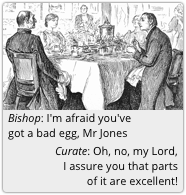
What is your opinion? Do you think Jamie excelled at it? Was he hopeless at it? Or just middling? Is this drawing a curate's egg?

middling: of average size, quality, status, etc. Medium or average; neither very good nor very bad. E.g. a golfer of middling talent ‘Do you like your coffee weak or strong?’ ‘Oh, middling, please.’ A man of about middling height. A middling performance. He was middling at school, and put his energies elsewhere. He was middling at studying, but a voracious reader who devoured whatever books he came across.  He was middling in all the games he played.

a curate's egg: a thing that is partly good and partly bad. E.g. this book is a bit of a curate's egg. Origin: early 20th century: from a cartoon in Punch (1895) depicting a meek (= quiet, gentle, and always ready to do what other people want) curate who, given a stale (= no longer fresh and therefore unpleasant to eat) egg at the bishop's table, assures his host that ‘parts of it are excellent’.


There are two ways to look at this. As a matter of fact, I am in a quandary. I really can't decide which is the correct way. 

quandary: /ˈkwɒndəri/ the state of not being able to decide what to do in a difficult situation. Dilemma. E.g.  George was in a quandary—should he go or shouldn't he? This placed the government in something of a quandary.

First of all, was this dishonest? Was he a rogue? 

rogue: /rəʊɡ/ a man who is dishonest.

Would you say Jamie lifted the drawing from Raymond Briggs's book? 

lift something (from something) to use somebody’s ideas or words without asking permission or without saying where they come from. Plagiarize. E.g. She lifted most of the ideas from a book she had been reading.


I am really not sure. I'm in a predicament. 


predicament /prɪˈdɪkəmənt/ a difficult or an unpleasant situation, especially one where it is difficult to know what to do. Quandary. E.g. the club’s financial predicament. I'm in a terrible predicament.


On the one hand, he remembers having no feelings of guilt whatsoever.  

whatsoever: not at all. Not of any kind. E.g. ‘Is there any doubt about it?’ ‘None whatsoever.’
 
But on the other hand, he remembers that he didn't divulge the secret about copying the image to anyone. He took the praise in full knowledge that the truth would probably have invalidated it.

divulge: /daɪˈvʌldʒ/ to give somebody information that is supposed to be secret. E.g. She refused to divulge the information. The plans must not be divulged to anyone.


But I also think that copy, remix and mashup are essential for any individual to develop drawing skills or indeed, to develop any creative process. So perhaps there was something honest, or at least necessary and natural going here.


remix: a new version of a recorded piece of music made by using a machine to arrange the separate parts of the recording in a different way, add new parts, etc. E.g. a remix of their first single. An Elton John remix.

mashup: /ˈmæʃʌp/ a combination of elements from different sources used to create a new song, video, computer file, program, etc. E.g. a video mashup. Most mashups are simple remixes that DJs have been doing for decades. It’s a new web service that allows people to create mashups of movies, combining scenes from various films.

necessary: /ˈnesəsəri/ /ˈnesəseri/ 

Who am I trying to fool?

Do you consider remixes and mashups  acts of stealing, of unoriginal thought, of plagiarism, of laziness,...?

Or, do you consider them creative and original cultural acts? Do you think most things are mashups? Can you think of examples where multiple ideas, products, music, literature, you name it, were mashed-up, remixed and recontextualized to create something completely new and original?


Happy holidays


Another idea for your scrapbook: